Showing posts with label ozarks. Show all posts

Friday, October 11, 2013

What's Happening In The Ozarks This Weekend!

Oct. 11 - The Red Cross will hold a blood drive at the Walmart in West Plains from 1-6 PM.


Oct. 11-12 - A Quilt Show sponsored by the Eminence Area Arts Council will be held at the Shannon County Museum & Art Gallery, Main St., in Eminence. For more information call 573-226-3531.


Oct. 11-12 - The Annual Fall Show and Tractor Pull will be held at the Ozarks Older Iron Club Grounds in Cabool starting at 9 AM. Admission is free.


Oct. 11 - The Baxter County Sheriff’s Office will be conducting a firearms qualification shoot for Retired Law Enforcement Officers on Friday, October 11, 2013 beginning at 9:00 AM. This will be held at the firing range on Baxter CR 782 off State Highway 201 North. The cost is $10, payable in advance. The retired officer must furnish his or her own firearm and ammunition. Certain restrictions apply, and firing range rules and other limitations will apply. Contact the Sheriff’s Office for further details at 870-425-7000.


Oct. 12 - The “Chopper Walkers” will be holding their 4th Annual Driving For A Cure Golf Tournament at 10 AM. Cost is $80 per team. All proceeds to benefit Relay For Life. You can call 417-274-1584 to register early or sign up day of tournament.


Oct. 12 - The Pride of the Ozarks Goat Breeding Club will meet at 1 PM at the Howell Oregon Electric Cooperative Building on Highway 63 in West Plains. For more information, call 417-764-3423.


Oct. 12 - Experimental Aircraft Association (EAA) Chapter 1218 of Willow Springs will be hosting their Annual Open House and Fly-In, Saturday, October 12, 10AM – 2PM at the chapter hangar, 810 Bryan Street, Willow Springs.


Oct. 12 - Kids Ages 7 & older are invited to “Fun & Games” at the West Plains Public Library on Saturday, October 12 from 2-3 PM.
Oct. 12 - The Red Cross will hold a blood drive at the Walmart in West Plains from 11 AM to 4 PM.


Oct. 12-13 - The Timbo Volunteer Fire Department will hold their bi-annual Gun and Knife Show from 9 AM to 5 PM Saturday, October 12 and 9 AM to 4 PM Sunday, October 13 at the Stone County Fairgrounds in Mountain View, AR. Admission is $5 for people 12 and older. All proceeds from the event will go to buy equipment for the Timbo VFD. For more information call 870-746-4349.


Oct. 12 - End of Me Ministries will hold a Bible Study at the OMC Community Room, 403 Washington Avenue, West Plains at 7 PM October 12.


Oct. 12-13 - The Haunting in the Hills will take place October 12 and 13 at The City Park in Eminence from 9 AM to 4 PM Saturday, October 12 and 10 AM to 3 PM Sunday, October 13. A special program, called Tales from the Ozark’s Dark Side, will take place from 6-9 PM Saturday, October 12. All activities are free. For more information go towww.ozarkheritageproject.org or call 573-663-2269.


Oct. 12-13 - The Fall 2013 Go Green Self Reliance Festival in Thayer has been canceled.


Oct. 12 - The Howell County Right-For-Life 5K Run will be held Saturday, October 12 in West Plains. For more information call 417-252-1399.


Oct. 12 - The Avenue Theater in West Plains will screen “Fancy Pants,” the 1950 Western comedy that was one of the first movies ever shown at the theater. As a salute to that era, admission to the event will be a dime. Also included that evening is a contest for who dons the fanciest pants.

Oct. 13- Oktoberfest party Sunday, October 13.  At the 88.1 radio station parking lot at 1211 Ozark in Cabool. There will be home-made rootbeer in a Rootbeer Garden, the best wurst around, and other snacks as well. A traditional Oktoberfest rummage sale which will be taking place at the same time. It starts at noon and goes until 4 p.m. Cabool. 


Oct. 13 - Dr. Bryan Sharp will be speaking at Eagle Heights Independent Baptist Church, CR 8570 in West Plains, at 10 AM, 10:45 AM and 2 PM. For more directions or more information, call 417-293-9888


Oct. 14 - The Community Blood Center of the Ozarks will hold a blood drive at Lutie School, Highway 160 in Theodosia, from 1:30-5 PM.


Oct. 14 - The Red Cross will hold a blood drive from 12-6 p.m. at Willow Springs United Methodist Church, 311 N. Harris St. in Willow Springs.


Oct. 15 - The Community Blood Center of the Ozarks will hold a blood drive at Ava High School from 11:30 AM to 5:30 PM.

Sunday, July 7, 2013

Oven Smoked Brisket


Oven Smoked Brisket 


Ingredients:

7-11 lb. brisket, untrimmed
1-2 bottles liquid smoke
1 tablespoon salt
4-6 tablespoons McCormick Montreal Grill Mate Steak Seasoning

Directions:

Trim brisket of excessive fat, but leave a nice layer for a wonderful flavor. Place brisket in a large roasting pan or in a ex large Ziploc bag. Pour liquid smoke over brisket and seal tightly. Place in the refrigerator for 6-8 hours or overnight.

Remove brisket from the refrigerator and let set for 1 hour. Preheat oven to 275 degrees F. Season brisket with salt and sprinkle Grill Mate Steak Seasoning on top of the fat side covering all the way to the edges. Place brisket fat side up on a rack inside of a roaster pan and cover with foil. Bake in the oven for 3 1/2 to 8 hours depending on the size. Remove from oven and transfer to a cutting board and let rest for 15-20 minutes before slicing. Serve with barbecue sauce.


Note: Cook brisket 30-45 minutes times per the pound of the brisket. 7 lb. brisket will cook for 3 1/2 hours to 5 1/2 hours. At the end of the resting time, you can slice the brisket and put it back in a baking dish and pour barbecue sauce over it and bake an additional 30-40 minutes.

Tuesday, July 2, 2013

How To Kill Poison Ivy & Other Weeds


Here's What You'll Need...


* Combine 1 gallon white vinegar with 1 cup salt and 2 TBSP blue dawn dish soap.

* Once all the ingredients have been mixed well pour mixture into a spray bottle.

* Spray poison ivy.  Be careful not to get it on your other plants because this mixture will kill anything you spray it on! 

Amish Macaroni Salad

Amish Macaroni Salad 


Ingredients
2 cups uncooked elbow macaroni
3 hard-cooked eggs, chopped
1 small onion, chopped
3 stalks celery, chopped
1 small red bell pepper, seeded and chopped
2 tablespoons dill pickle relish
2 cups creamy salad dressing (e.g. Miracle Whip)
3 tablespoons prepared yellow mustard
¾ cup white sugar
2¼ teaspoons white vinegar
¼ teaspoon salt
¾ teaspoon celery seed

Directions
1. Bring a pot of lightly salted water to a boil. Add macaroni, and cook for 8 to 10 minutes, until tender. Drain, and set aside to cool. 2. In a large bowl, stir together the eggs, onion, celery, red pepper, and relish. In a small bowl, stir together the salad dressing, mustard, white sugar, vinegar, salt and celery seed. Pour over the vegetables, and stir in macaroni until well blended. Cover and chill for at least 1 hour before serving.

Wednesday, June 26, 2013

Glow In The Dark Pots For Planting

Buy a flower pot that you really like and use Rustoleum's Glow-in-the-dark paint to paint the pot. During the day, the paint will absorb the sunlight and at night the pots will glow.


Sunday, June 16, 2013

Many uses of Aloe Vera

There is nothing on this planet that offers the amazing variety of healing benefits granted by aloe vera. In a single plant, aloe vera offers potent, natural medicine that:

• Halts the growth of cancer tumors.
• Lowers high cholesterol.
• Repairs "sludge blood" and reverses "sticky blood".
• Boosts the oxygenation of your blood.
• Eases inflammation and soothes arthritis pain.
• Protects the body from oxidative stress.
• Prevents kidney stones and protects the body from oxalates in coffee and tea.
• Alkalizes the body, helping to balance overly acidic dietary habits.
• Cures ulcers, IBS, Crohn's disease and other digestive disorders.
• Reduces high blood pressure natural, by treating the cause, not just the symptoms.
• Nourishes the body with minerals, vitamins, enzymes and glyconutrients.
• Accelerates healing from physical burns and radiation burns.
• Replaces dozens of first aid products, makes bandages and antibacterial sprays obsolete.
• Halts colon cancer, heals the intestines and lubricates the digestive tract.
• Ends constipation.
• Stabilizes blood sugar and reduces triglycerides in diabetics.
• Prevents and treats candida infections.
• Protects the kidneys from disease.
• Functions as nature's own "sports drink" for electrolyte balance, making common sports drinks obsolete.
• Boosts cardiovascular performance and physical endurance.
• Speeds recovery from injury or physical exertion.
• Hydrates the skin, accelerates skin repair.

Truly, there is nothing else that compares to the medicinal potential of aloe vera. And yet most people only know about the topical applications of aloe vera gel. They think it's only good for sunburns. In reality, aloe vera is useful for both external and internal use. 

Full article:http://www.naturalnews.com/021858_aloe_vera_gel.html


Friday, May 10, 2013

Local Event - Cabool Farm Fest and Outdoors in the Ozarks Expo


The Cabool Area Chamber of Commerce will be hosting the 30th annual Farm Fest and Outdoors in the Ozarks Expo on May 10-11.

Events scheduled for Farm Fest include a 3D pop-up archery competition, chainsaw drag races, seminars, a carnival and more.

Admission and parking for the event is free.

For more information, visit www.caboolmo.org or call the Chamber of Commerce at 417-962-3002.

Wednesday, May 8, 2013

Difference in Eggs


The color of the yolk is an indication of the presence of nutrients. The pastured egg on the left is a dark orange color. The organic store egg in the center is slightly less orange. The supermarket egg on the right is paler and might even be white were orange foods and dyes not given to the chickens. By the way, chickens producing organic eggs are mostly raised in barns, not on pasture. Conditions are certainly better than those for the typical battery egg. However, the USDA has determined that the chicken is a vegetarian, and they can be given no animal foods. Chickens are in fact, omnivores, and their eggs will be much healthier if they are getting animal foods. The pastured egg and the organic egg both have two parts to the white, a viscous part around the yolk and then a thinner part around the edges. This is a sign of freshness.

Tuesday, April 30, 2013

HOW TO: Cook Corn in Husks


Instructions:


1. Remove a few of the outer husks that might be dirty.

2. Cut the bottoms off of the corn. Be sure to cut above the part of the cob where the husk is attached. It would be above the part of the cob where it starts to round down.

3. Place a moist paper towel on the bottom of the microwave or on top of the carousel and place the corn on the paper towel.

4. Use this guide for your cook time. Remember the cooking time can vary for each microwave.

1 ear - 2 minutes
2 ears - 3 to 4 minutes
3 ears - 5 to 6 minutes
4 ears - 7 to 8 minutes
6 ears - 8 to 9 minutes

5. After cooking, let the corn sit about 3 minutes. It will continue to cook and will be cooler and easier to handle.

6. Pick the cooked corn up by the top (you might want to use an oven mitt if it is too hot to handle) and squeeze and lightly shake out the ear of corn. It should just slide out leaving the silk and all of the husks intact.

Tuesday, April 16, 2013

Monday, April 15, 2013

How to: Save Heirloom Tomato Seeds

Saving your own tomato seeds is rather fun and has all sorts of benefits. Preserving heirloom seeds, ensuring a supply of your own favorites for next year, helping protect seed diversity, making a giant mess of stinky fermenting goo, it’s all there! It’s also pretty easy.


 As part of our seed selling business we save fairly large quantities of tomato seed but the process is the same whether you are saving from a pile of heirloom tomatoes or from a paticularily tasty one you just sliced up for lunch.


First things first, you need to get your tomato seeds out of the tomato.  You can slice them in half, in quarters, scoop some out of the one you’re eating or just use my preferred method: Squishing. A serrated grapefruit spoon makes a great seed saving tool, especially when dealing with smaller cherry tomatoes. Just cut them in half and scoop out the inside of the tomatoes leaving the skin and outer flesh behind.


Next the seed pulp is ready to be combined with water in a container.  Glass jars are simple and food safe, but yogurt containers and tupperware are perfectly suitable. The only really important factor is that the container needs a lid. It’s going to get stinky so the lid is not optional.


Make sure to label each variety as you go as tomato seeds all look very similar and the colored pulp is going to break down.
Place them out of direct sunlight and walk away for a few days. You’ll start to see the good seeds settle from the pulp down to the bottom of the container.


Now things will start to ferment. This fermentation process is breaking down the protective coating on each seed. After a few days and once you have a good layer of fuzzy stuff, dump it off, leaving the seeds in the bottom of the jar.  Any seeds at the top are duds, the good stuff is all at the bottom.  Top up the jar with some clean water and let it all happen again.  Once the seeds are starting to settle cleanly at the bottom they are done. Be careful not to leave things unsupervised for too many days as the seeds could start germinating.


Once the seeds are ready, pour off any remaining pulp and mold.
Using a strainer, give your seeds a final rinse. They should be looking rather naked by now.


Now you just need to let them dry.  A stack of clean rags or old tea towels work best, as paper towels sometimes stick.

Once again, label your seeds. Package them up a few days later when they’re perfectly dry and you’re set.  Next spring you’ll have more tomato seeds then you can plant.  Trading them with fellow seed savers and planting a few extra for gardening neighbors is highly recommended.


Thursday, April 11, 2013

DIY Water Hose Storage / Cleaning Station

This is just the neatest idea & is so handy for the garden! Your diy wash station that is so simple & get's the water hose of the ground. Make it your own.  This example shows a galvanized  pail screwed to a 2 x 4 that is in the ground with a bird house on the top. Roll the hose around the pail & inside a place to store brushes, small garden tools, and a great place to hang a towel! I just love it & is gonna be a summer project for me!

Tuesday, April 9, 2013

LOCAL EVENT: Gun & Knife Show Mountain View, AR

Gun & Knife Show

April 13 - April 14, 2013

Mountain View, Arkansas


Stone  County Fairgrounds, Mountain View, Arkansas

Saturday: 9:00am-4:00pm
Sunday: 9:00am-4:00pm


Admission is $5.00 per person 12 & older


For more information about this event -


timbovfd@hotmail.com


PHONE  870-746-4349

Brought to you by the Timbo Volunteer Fire Department

All proceeds to go the 
Timbo Volunteer Fire Department & First Responders.

Wednesday, April 3, 2013

2013 Missouri Spring Turkey Hunting - Regular Season: April 15-May 5


Missouri Spring Turkey Hunting 


2013 Seasons
Youth Season: April 6-7
Regular Season: April 15-May 5


There are several changes to conservation area regulations and managed turkey hunts. Check pages 8 through 17 of the 2013 Spring Turkey Hunting Regulations and Information booklet listed below for details.


Youth Spring Turkey Hunting Season
Who May Participate:
The youth hunter must be age 6–15 on opening day.

Season Dates:
April 6-7, 2013

Shooting Hours:
One-half hour before sunrise to sunset Central Daylight Time

Valid Permits:
Youth hunters must possess one of the three following permits:

Resident Spring Turkey Hunting Permit
Resident Landowner Spring Turkey Hunting Permit
Nonresident Spring Turkey Hunting Permit
Note: Landowner permits are valid only on the land for which they are issued.

Youth Season Limit:
One male turkey or turkey with visible beard

NOTE: Youths who take a turkey during the youth season may not harvest a second bird until April 22. This is because the bird taken during the youth season counts as the first bird for the first week of the regular season.


Regular Spring Turkey Hunting Season
Season Dates:
April 15 –May 5, 2013

Shooting Hours:
One-half hour before sunrise to 1 p.m. Central Daylight-Saving Time

Valid Permits:
Resident Spring Turkey Hunting Permit
Resident Landowner Spring Turkey Hunting Permit
Nonresident Spring Turkey Hunting Permit
Season Limit:
Two male turkeys or turkeys with visible beard may be taken during the season, with the following restrictions:

You may only take one turkey during the first week from April 15 –21.
If you do not take one during the first week, then you may take two during
the second or third week from April 22–May 5, but you may not take them both on the same day.
NOTE: If you hunt during a managed hunt, season limits still apply.


*Above Information from Missouri Department of Conservation


Homestead Crossing Inc. has great hunting land for lease available. Don't want to lease? Buy your own land with owner finance options!  Contact Ed Johnson at 417-252-1067 Today!

From Everyone here at Homestead Crossing Inc have a safe & fun Turkey Hunting Season! 


Tuesday, March 26, 2013

Cooking On A Log


Cooking on a log...


Cut the log evenly on both sides so it stands up freely. Then cut it into vertical segments most of the way down the length of the log. Stuff in some newspaper into the cracks as deep as you can get it, leaving a wick at the bottom, and light it up.
That's all there is to it—the log burns from the inside out, and you have a simple, handmade stove.


Friday, March 22, 2013

Missouri’s Wild Turkey Population Remains Strong


Missouri’s Wild Turkey Population Remains Strong

Missouri is recognized as offering some of the nation’s best turkey hunting. Each year, the state’s turkey harvest ranks among the highest in the country. The improved production of 2011 should result in an increase in the number of 2-year-old gobblers during the 2013 spring season. The hatch of 2012 should continue this trend into 2014. Missouri’s turkey population remains strong, offering hunters a tremendous opportunity to enjoy one of the state’s most cherished natural resources.

By the Missouri Department of Conservation

Spring Turkey Season Starts April 15!


Tuesday, December 18, 2012

Treasure of the Ozarks: Laura Ingalls Wilder Home to be Upgraded & Renovated for $2 Million!


Many of us are familiar with the books and the T.V Show "Little House on the Prairie" from Laura Ingalls Wilder, and according to "Greene" magazine, an Ozarks based and all about the Ozarks magazine, tells us that for about $2 million the Mansfield, Missouri historic home of the famous writer will be renovated and turned into a "historic home and museum" on Rocky Ridge Farm which will "assure the Wilder homestead its rightful legacy" states the author, George Freeman.  Tim Rosenbury, architect from Springfield, MO will be on the job for the renovation of the Rocky Ridge Farm.


Check out Laura's home on Rocky Ridge Farm!

If you're like many of us who long for the day to go back to the "simple" life of way back when and live much like the families within Laura's "Little House" books and are interested in homesteading on land with no building restrictions, or maybe you're looking to be the next Laura Ingalls Wilder let us help you with your source for inspiration!

Monday, December 10, 2012

Save Money by Saving Seeds: Here's How to Do It!


We're edging into the Winter months, but Spring is on the mind for those who are looking ahead at gardening and planting time, so here's some tips to keep in mind when growing your crops this coming up 2013 year for saving seeds for the future. You can save $ money $ and can make a little, too!

7 Reasons to Save Seeds:
  1. Money Savings. When you buy seeds, invest in high-quality seeds for the first planting, then you will have high quality seeds in a much higher volume to save, thus saving you more money in the long run.
  2. Seed Security. Instead of industry corporations who have discontinued some varieties of seeds to sell lucrative hybrid seeds, saving your own seeds gives you seed security in the fact that you control the supply of the seed variety you chose to plant, especially now hard to find seeds that aren't always available in the catalog (perhaps offer extra seeds to sell to other interested gardeners thus making you more money).
  3. Regional Adaption. When you save seeds grown on your land and in your climatic environment, you are developing over time, better adapted varieties best suited to your soil and climate conditions and growing practices.
  4. Consistent Quality: Corporations use open pollination in their seed crops, which means that their seed packets may contain several off-type seeds because they rarely rogue their fields for bad or poorly growing plants, which then pollinate and add to the seed crop. In saving your seeds and doing the picking, cleaning and hoeing yourself, you pull out the suckers, the weaker plants, etc and thus provide a more consistent pollination to your own seed crop that has better quality seeds each time you plant.
  5. The Joy of Learning.  The more seeds you save the more you learn about botany and the plant kingdom, this is a great thing for kids to get into especially for science projects!
  6. Explore Heirloom Varieties. Some people like to grow heirloom varieties because doing so gives them a connection to our garden heritage, others choose non-hybrid seeds because they don't want to support the industrial Agriculture system that is increasingly controlling our food supply and some older, open-pollinated varieties produce more nutritious crops than do modern hybrids bred mostly for high yields and long shelf life.
  7. Influence Crop Traits. Gene pools are incredibly elastic. By carefully observing your plants, you can save seed from those plants that best meet your needs for germination, ripening time, yield, specific fruit shape, flavor, storage, qualities, less seediness, better disease resistance, bloom color, or other unique trait within the variety of plant. Over time, most of the plants you grow from your saved seeds will end up having the desired traits you like.
Seed-Saving Tips
 

  • Always choose OP (Open-Pollinated) varieties for seed saving, these are non-hybrid plants with seed that's true generation after generation. (Self & Cross-Pollinating plants are OP)
  • The easiest crops to save seeds from are: peas, beans, tomatoes, and peppers (Self-Pollinators).
  • Cross-Pollinating crops need to be isolated from other varieties of the same species. The simplest solution is to grow only one variety of a given species and you can just save seeds from one or two plants, but to maintain long-term health and vigor, you should buy new seed every few years or trade seeds with other growers. Cross-Pollinating crops to save seeds from are: brassicas, corn, carrots, beets, squash, cucumbers, and melons.
  • Soak "wet" seeds, like Tomatoes and Squash which have a gel sac around the seeds that prevents germination, in order to remove the sacs and dry on a screen.
  • Seed crops are often harvested at different times than food crops, in order to keep your garden organized and track of which crop you want for seed, mark off the row with a ribbon or tie or other marker that you will know means a seed crop.
  • Flower heads are usually harvested as they dry.
  • Using screens as filters or rubbing seed pods between your hands is a couple ways to remove chaff from the seed.
  • Store seeds in glass jars, plastic bags or paper envelopes. Though glass is always best as it prevents moisture from getting to the seeds. (I have used baby food jars for small amounts of seed saving, but they are thoroughly washed, sterilized and dried before putting in the seeds).
  • Store seeds in a cool, dry place, ideally at less than 50 degrees Fahrenheit and at a relative humidity level of less than 50 %. In general, for every 10 degrees colder the storage conditions, seed longevity doubles, so it's best to keep seed in a covered container in a refrigerator. As long as the seed is very dry, it will last longest if you keep it in a freezer. All seed should be dried to a brittle state, ideally less than 14 % moisture (so ice crystals don't form on the seeds while in a freezer). When you're ready to use freezer stored seeds, allow the storage jar to come to room temperature before opening it to avoid condensation on the seed.

Cite:
**(Information acquired from Mother Earth News Magazine, December 2012/January 2013 edition, Article " Saving Seed 7 Reasons Why and Dozens of Tips for How" by Roberta Bailey pgs 38-44 )**

Friday, October 19, 2012

Best MO Counties for Hunting Bucks as per Missouri Game & Fish Magazine!

Just found a wonderful spread in the Missouri Game & Fish Magazine about the Top Counties per Region in Buck Harvest for last year, which serves as a great forecast for this hunting season!

The article is on page 32-34 & continues on page 57 from the November 2012 issue.

For our area which is the Eastern Ozarks the top county is Texas, followed by Howell and then Wayne counties. The buck harvest for 2011 in Texas County was 1,987, Howell County 1,888 and Wayne County 1,477 that's a lot of bucks, mounts and deer chili for dinner! Now the article does go into the surrounding counties but I wanted to highlight on the areas where we have most of our owner financed land and hunting leases.


"This 17-county region [ Eastern Ozarks Region] came in fourth place out of eight regions in the estimated number of antlered deer with 52,681 bucks.  Hunters reported taking 20,112 antlered deer in this region last year, which also ranked it near top at second place statewide. The top three antlered buck harvest counties in were Texas 1,987 (first statewide); Howell 1,888 (second); and Wayne with 1,477 (11th). None of the 17 counties in this region are included in the APR zone. [Antler Point Restrictions]" (Missouri Game & Fish, "Missouri's 2012 Deer Outlook-Part 2 Finding Trophy Bucks" by Tony Kalna Jr, page 57)

The article continues to say that "a trophy buck can be killed just about anywhere in Missouri, but the numbers don't lie. Some counties and regions simply are better when it comes to having more bucks and more trophy-class bucks." So, this bodes well for this years hunting season, if you've been wondering where your next big buck and possible winner of the Boone and Crockett record breaker is, then why not come down into Howell and Texas counties here in the Missouri Ozarks and bag your next big break!

Tuesday, October 2, 2012

How to Salvage Junk and use it for your Garden as a Root Cellar or Veggie Storage!

You might be thinking, "I don't want junk in my garden, why would I salvage junk?!" 

      Well, let me explain, instead of going to the expense of putting in a cellar yourself, whether through paying for physical labor, the cost of cement, etc you can simply bury a large freezer that no longer works and putting straw, raked up leaves or other insulation material on top of tarp that covers the top of the freezer door, this helps keep out critters and keep your stored food insulated in the winter months, or perhaps you need something larger and assuming you have the space for it, ever consider making use of that old, broke-down school bus lying in the local junk yard by burying it up to the rear access doors? Voila, instant Root Cellar! What about that old galvanized trash can out back that's just taking up space, bury that and you have a great little covey for your root veggies, all you need is straw for insulation and it's already rodent-proof!

That get your attention?

 Good!

 Now let me delve further into the method to this madness.


 First off, be mindful of where you stash your garden treasure troves, preferably on the Northern side of your land or home and remember keep safety in mind, disable latches so kids or elderly don't get trapped in by accident.

Bury A School Bus!
http://4.bp.blogspot.com/-1jvcpEFQghE/T4bv1167SvI/AAAAAAAAELI/BHusD_GtZPs/s1600/root-cellar3.jpg


Consider burying a junked school bus, yes you will need to dig a proper sized hole and make sure that the bus is water tight (sealant or wrapping will be needed) and you will also have to allow for access to the rear doors and be sure to board up the windows and seal them for effective insulation. Also, you will need at least two PVC pipe vents for air flow as with any root cellar.

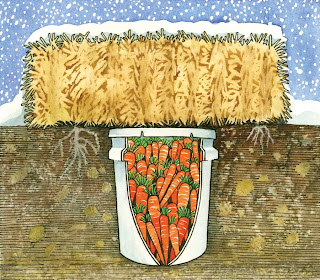
Bury Garbage Cans:


(Image from Mother Earth News )

    You can also use Garbage cans that are sealed or galvanized for smaller storage areas or land allotments, you simply need a can (cut the bottom out or poke holes for drainage), straw and a bit of dirt for the inside in order to place your winter squash and root veggies in, the straw will be used to cover the top of the lid of the trash can in order to insulate it- of course you will need to dig a hole big enough to stick your can into.

To access your veggies, simply remove the tarp (opt), straw bale, and lift off the lid (if you want an additional security from rodents and moisture, put black tarp down over the straw bale on top of the lid and make sure there are drainage ditches on either side of the can and secure the tarp with cement blocks or heavy rocks) and then snatch however many veggies you need for supper and replace your insulation!

Remember to layer leaves or straw between the veggies!


Figure 4. A well box that supports an access hatch above ground level
Here is a good article from Back Woods Home Magazine that shows you how to build a small cold storage bin.

 Bury a Freezer or Refrigerator:
 

Stuff You’ll Need:
Straw Bales
Clear Plastic Sheeting
Plastic Sheeting
Shovel and Pick
Old Deep-freeze Or Refrigerator

Step 1:
Remove motor, shelves and lock from door (so no child can get locked inside).
Step 2:
Dig a hole large enough to hold the deep freeze where the top of the freezer is ground level or slightly below ground level.
Step 3:
Place some rocks in bottom of the hole for drainage.
Step 4:
Place the freezer into hole on its back. The door will open like a lid.
Step 5:
Fill around freezer with soil.
Step 6:
Place vegetables in freezer. Follow storage guidelines for vegetables just as if you were using a cellar.
Step 7:
Cover freezer with a sheet of plastic to keep water from freezing the lid shut.
Step 8:
Place bags of leaves or bales of hay or straw on top of the freezer to help with cold weather.

 Notes: Dig the hole one foot larger than the refrigerator on all sides to create drainage.  The refrigerator should sit just below ground level.  Line the hole with gravel or rocks.   Pour gravel in the space around the sides of the refrigerator.  Run a small vent pipe into the refrigerator for ventilation. Protect from water by covering the top with a large mat, board or other water resistant material.  Cover with bales of hay or straw to insulate. 

The amount of insulation will depend on your cold weather climate, so insulate accordingly, some will need more some less.

Looking for land in Missouri, Arkansas, Texas, or Minnesota in which to start your own homestead or garden in order to try out these new ideas?