Showing posts with label owner financing. Show all posts

Monday, November 5, 2012

Homesteading in a Camper or Travel Trailer during Winter

I reviewed some online articles concerning how to homestead in a travel or camper trailer during the Winter to keep warm in about -9 degrees F, these helpful tips were gleaned from "The Tiny Voice of Reason"  and Homesteading Today's websites/forums.


026
    You can use hay bales as insulation for the skirting around your travel or camper trailer, however, keep in mind that the mice will be moving in and that hay is prone to spontaneously combust and is a fire hazard. Another form of insulation that would work would be creating a wind break by using permaculture, or various sized plants in pots or planted in the ground in various heights and staggering areas to create a barrier for the wind as wind is the main cause of heat loss during Winter, especially if you have no trees or are in an open area.

    Wood siding for sheds is a good skirting for campers and trailers for winter, consider adding foam board and heavy plastic to the underside of the trailer and over the crawlspace to conserve more heat and buff the cold winter winds. Also, get the vent cushions to cover your AC during winter, these are often found in RV stores or online.

   Buy some cheap shower curtain liners, fold them in half, cut to your window size and put them over the windows on the outside of the camper/trailer just to where they overlap the window frame (and if you have a patio door frame, do the same) and make sure to tape with outdoor heavy duty tape found at Home Depot or other hardware stores and also consider caulking with wet weather caulk on the interior of the camper/trailer where there's cracks, such as around the around the main doors, windows & closet seams where they meet the floor and use expanding foam to fill the areas around the floor seam of the popout if you have one.

rv homesteading
   Invest in Styrofoam insulation panels (12 pack for $8) from Home Depot and  put those inside the cabinets, closets, the storage space in the bedroom closet and under the sinks.  Under the tub, and that small space behind the toilet where the pipe sits in front, and stuff in fiberglass bats and make an inside cover with a square piece of Styrofoam insulation. Insulate your sinks as well!

    Put a wool blanket under your flat sheet on your bed, and consider layering two or three thick microfiber blankets on top for warmth when you sleep, also layer thin and thick blankets for your bed coverings, layers do wonders and if you don't have electricity, consider investing in a hot water bottle or pack, otherwise plug in that heating blanket!

    Put thermal curtains or blankets over your windows, open them while the sun is out for passive solar heating and close them up when it starts to get dark. Also, consider painting a few 2 Liter soda bottles black, fill them with water and let the sun heat them up during the day outside, bring them inside to let the warmth leach into the camper/trailer, if you find one or two isn't enough try a few more but larger water containers will take longer to heat up and may end up freezing and having the opposite effect instead.

Invest in a generator if money allows and stock up on fuel when it's the cheapest. Do not store fuel next to your camper/trailer, but in a safe area a good distance away in approved containers.

Some have installed wood stoves into their travel trailers, this can be a dangerous fire hazard and if you have one installed make sure that you have at least two fire distinguishers handy and never leave your camper/trailer unattended with a live fire in the wood stove.


Friday, October 19, 2012

Best MO Counties for Hunting Bucks as per Missouri Game & Fish Magazine!

Just found a wonderful spread in the Missouri Game & Fish Magazine about the Top Counties per Region in Buck Harvest for last year, which serves as a great forecast for this hunting season!

The article is on page 32-34 & continues on page 57 from the November 2012 issue.

For our area which is the Eastern Ozarks the top county is Texas, followed by Howell and then Wayne counties. The buck harvest for 2011 in Texas County was 1,987, Howell County 1,888 and Wayne County 1,477 that's a lot of bucks, mounts and deer chili for dinner! Now the article does go into the surrounding counties but I wanted to highlight on the areas where we have most of our owner financed land and hunting leases.


"This 17-county region [ Eastern Ozarks Region] came in fourth place out of eight regions in the estimated number of antlered deer with 52,681 bucks.  Hunters reported taking 20,112 antlered deer in this region last year, which also ranked it near top at second place statewide. The top three antlered buck harvest counties in were Texas 1,987 (first statewide); Howell 1,888 (second); and Wayne with 1,477 (11th). None of the 17 counties in this region are included in the APR zone. [Antler Point Restrictions]" (Missouri Game & Fish, "Missouri's 2012 Deer Outlook-Part 2 Finding Trophy Bucks" by Tony Kalna Jr, page 57)

The article continues to say that "a trophy buck can be killed just about anywhere in Missouri, but the numbers don't lie. Some counties and regions simply are better when it comes to having more bucks and more trophy-class bucks." So, this bodes well for this years hunting season, if you've been wondering where your next big buck and possible winner of the Boone and Crockett record breaker is, then why not come down into Howell and Texas counties here in the Missouri Ozarks and bag your next big break!

Tuesday, October 2, 2012

How to Salvage Junk and use it for your Garden as a Root Cellar or Veggie Storage!

You might be thinking, "I don't want junk in my garden, why would I salvage junk?!" 

      Well, let me explain, instead of going to the expense of putting in a cellar yourself, whether through paying for physical labor, the cost of cement, etc you can simply bury a large freezer that no longer works and putting straw, raked up leaves or other insulation material on top of tarp that covers the top of the freezer door, this helps keep out critters and keep your stored food insulated in the winter months, or perhaps you need something larger and assuming you have the space for it, ever consider making use of that old, broke-down school bus lying in the local junk yard by burying it up to the rear access doors? Voila, instant Root Cellar! What about that old galvanized trash can out back that's just taking up space, bury that and you have a great little covey for your root veggies, all you need is straw for insulation and it's already rodent-proof!

That get your attention?

 Good!

 Now let me delve further into the method to this madness.


 First off, be mindful of where you stash your garden treasure troves, preferably on the Northern side of your land or home and remember keep safety in mind, disable latches so kids or elderly don't get trapped in by accident.

Bury A School Bus!
http://4.bp.blogspot.com/-1jvcpEFQghE/T4bv1167SvI/AAAAAAAAELI/BHusD_GtZPs/s1600/root-cellar3.jpg


Consider burying a junked school bus, yes you will need to dig a proper sized hole and make sure that the bus is water tight (sealant or wrapping will be needed) and you will also have to allow for access to the rear doors and be sure to board up the windows and seal them for effective insulation. Also, you will need at least two PVC pipe vents for air flow as with any root cellar.

Bury Garbage Cans:
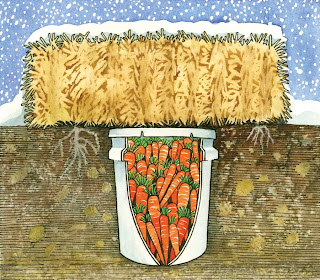


(Image from Mother Earth News )

    You can also use Garbage cans that are sealed or galvanized for smaller storage areas or land allotments, you simply need a can (cut the bottom out or poke holes for drainage), straw and a bit of dirt for the inside in order to place your winter squash and root veggies in, the straw will be used to cover the top of the lid of the trash can in order to insulate it- of course you will need to dig a hole big enough to stick your can into.

To access your veggies, simply remove the tarp (opt), straw bale, and lift off the lid (if you want an additional security from rodents and moisture, put black tarp down over the straw bale on top of the lid and make sure there are drainage ditches on either side of the can and secure the tarp with cement blocks or heavy rocks) and then snatch however many veggies you need for supper and replace your insulation!

Remember to layer leaves or straw between the veggies!


Figure 4. A well box that supports an access hatch above ground level
Here is a good article from Back Woods Home Magazine that shows you how to build a small cold storage bin.

 Bury a Freezer or Refrigerator:
 

Stuff You’ll Need:
Straw Bales
Clear Plastic Sheeting
Plastic Sheeting
Shovel and Pick
Old Deep-freeze Or Refrigerator

Step 1:
Remove motor, shelves and lock from door (so no child can get locked inside).
Step 2:
Dig a hole large enough to hold the deep freeze where the top of the freezer is ground level or slightly below ground level.
Step 3:
Place some rocks in bottom of the hole for drainage.
Step 4:
Place the freezer into hole on its back. The door will open like a lid.
Step 5:
Fill around freezer with soil.
Step 6:
Place vegetables in freezer. Follow storage guidelines for vegetables just as if you were using a cellar.
Step 7:
Cover freezer with a sheet of plastic to keep water from freezing the lid shut.
Step 8:
Place bags of leaves or bales of hay or straw on top of the freezer to help with cold weather.

 Notes: Dig the hole one foot larger than the refrigerator on all sides to create drainage.  The refrigerator should sit just below ground level.  Line the hole with gravel or rocks.   Pour gravel in the space around the sides of the refrigerator.  Run a small vent pipe into the refrigerator for ventilation. Protect from water by covering the top with a large mat, board or other water resistant material.  Cover with bales of hay or straw to insulate. 

The amount of insulation will depend on your cold weather climate, so insulate accordingly, some will need more some less.

Looking for land in Missouri, Arkansas, Texas, or Minnesota in which to start your own homestead or garden in order to try out these new ideas?