Tuesday, October 30, 2012

Build a High-Protein Dispenser for FREE Chicken Food!

Found a nice little article that will help all those who have chickens, through the winter and the rest of the year saving you money by feeding natural, and high-protein, and FREE feed to your chickens with a little material found 'round the homestead or farm with a dollar or two thrown in for some minor materials.

The article I gleaned this info from is out of the "Countryside & Small Stock Journal" Vol 96 No. 6 November/December 2012, Page 61, by Jeff Hoard.

Basically the articles author explains how to create a maggot dispenser for your chickens using some simple materials:
  • Flat plywood- to put under dispenser to catch & feed chickens on a clean surface.
  • 5 gal. bucket with lid, bottom cut out but leave a 1" lip around it to hold a round piece of grate or heavy wire mesh.
  • Grate or Heavy Wire Mesh
  • Charge (dead animals, meat scraps, or raw fatty meat products. Don't use anything sick or dying.)
  • PVC Coupler
  • Long piece of ABS pipe
  • Auto Heater Vent Hose
  • Skirting-for little bird & wind barrier
  • Tools for cutting & Drilling
 The author goes on to explain how he put the dispenser together and how it works:

     "I mentioned ours being a deluxe model and I'll explain. The hanger/vent was made out of scrap pipe. At the top I inserted a long piece of ABS pipe. The horizontal hanger is another short pipe that is welded over a hole that I cut in the main vertical pipe. A little below that are two more short pieces of pipe in a v-shape that stick out on each side of the hanging bucket. These serve as bumpers. On the lid of the bucket, I inserted an appropriate sized PVC coupler and a piece of auto heater vent hose, which attaches from there up to the hanging pipe.  This is how the odor is vented up and out at the top of the long ABS pipe. Like the vent system, the "skirt" that was installed on the bucket is certainly not a necessity but does perform some added functions. first, it keeps smaller birds from hanging off the bottom trying to eat their fill. Second, the skirt serves as a wind catch. Third, as the chickens go for the maggots they hit the skirt to hopefully dislodge a few more. Fourth, it helps keep the charge from drying out (very important). I did drill one small hole in the center at the top of the bucket's lid to allow for moisture to be added onto the charge if needed. " (page 63)

The author continues with some tips, "Install the dispenser 20 ft away from the chicken house,  in the shade, this will help draw the flies away from the flock and the flies are immediately drawn to the charge. They then lay their larvae on the charge and the larvae then turn into maggots, hundreds at a time and as they grow larger they get heavier and eventually fall through the grate and onto the plywood below to be gobbled up by a waiting chicken. It usually takes about 5 days for the maggots to start dropping and as long as the charge is refreshed," there is a constant supply of high-protein feed for your chickens and it's free! Chickens can keep laying with this feed and greens for quite some time, without the need for corn scratch!

I scanned the image directly from the magazine in order to show you all what they've created and about how it'll look when finished. It's in pdf form so you will need Adobe PDF viewer to see the file>> PDF




Tips for the Cold & Flu Season without Meds

Got these helpful tips from webmd.com 

8 Tips to Treat Colds and Flu the 'Natural' Way

With no cure in sight for the cold or the flu, over-the-counter treatments can at best bring symptom relief or shorten the duration of those symptoms. Or you can take the natural approach. WebMD explores some home remedies that may help you feel better along the way.

No. 1: Blow Your Nose Often -- and the Right Way

It's important to blow your nose regularly when you have a cold rather than sniffling mucus back into your head. But when you blow hard, pressure can cause an earache. The best way to blow your nose: Press a finger over one nostril while you blow gently to clear the other. Wash your hands after blowing your nose.

No. 2: Stay Rested

Resting when you first come down with a cold or the flu helps your body direct its energy toward the immune battle. This battle taxes the body. So give it a little help by lying down under a blanket.

No. 3: Gargle

Gargling can moisten a sore throat and bring temporary relief. Try a teaspoon of salt dissolved in warm water, four times daily. To reduce the tickle in your throat, try an astringent gargle -- such as tea that contains tannin -- to tighten the membranes. Or use a thick, viscous gargle made with honey or a mixture of honey and apple cider vinegar, a popular folk remedy. Steep one tablespoon of raspberry leaves or lemon juice in two cups of hot water and mix in one teaspoon of honey. Let the mixture cool to room temperature before gargling. Honey should never be given to children less than 1 year old.

No. 4: Drink Hot Liquids

Hot liquids relieve nasal congestion, help prevent dehydration, and soothe the uncomfortably inflamed membranes that line your nose and throat.

No. 5: Take a Steamy Shower

Steamy showers moisturize your nasal passages and relax you. If you're dizzy from the flu, run a steamy shower while you sit on a chair nearby and take a sponge bath.

No. 6: Apply Hot or Cold Packs Around Your Congested Sinuses

Either temperature may help you feel more comfortable. You can buy reusable hot or cold packs at a drugstore. Or make your own. Take a damp washcloth and heat it for 55 seconds in a microwave (test the temperature first to make sure it's not scalding). Or take a small bag of frozen peas to use as a cold pack.

No. 7: Sleep With an Extra Pillow Under Your Head

This will help with the drainage of nasal passages. If the angle is too awkward, try placing the pillows between the mattress and the box springs to create a more gradual slope.

No. 8: Don't Fly Unless Necessary

There's no point adding stress to your already stressed-out upper respiratory system, and that's what the change in air pressure will do. Flying with cold or flu congestion can hurt your eardrums as a result of pressure changes during takeoff and landing. If you must fly, use a decongestant and carry a nasal spray with you to use just before takeoff and landing. Chewing gum and swallowing frequently can also help relieve pressure.
Remember, serious conditions can masquerade as the common cold and a mild infection can evolve into something more serious. If you have severe symptoms or are feeling sicker with each passing day, see a doctor.

Friday, October 19, 2012

Best MO Counties for Hunting Bucks as per Missouri Game & Fish Magazine!

Just found a wonderful spread in the Missouri Game & Fish Magazine about the Top Counties per Region in Buck Harvest for last year, which serves as a great forecast for this hunting season!

The article is on page 32-34 & continues on page 57 from the November 2012 issue.

For our area which is the Eastern Ozarks the top county is Texas, followed by Howell and then Wayne counties. The buck harvest for 2011 in Texas County was 1,987, Howell County 1,888 and Wayne County 1,477 that's a lot of bucks, mounts and deer chili for dinner! Now the article does go into the surrounding counties but I wanted to highlight on the areas where we have most of our owner financed land and hunting leases.


"This 17-county region [ Eastern Ozarks Region] came in fourth place out of eight regions in the estimated number of antlered deer with 52,681 bucks.  Hunters reported taking 20,112 antlered deer in this region last year, which also ranked it near top at second place statewide. The top three antlered buck harvest counties in were Texas 1,987 (first statewide); Howell 1,888 (second); and Wayne with 1,477 (11th). None of the 17 counties in this region are included in the APR zone. [Antler Point Restrictions]" (Missouri Game & Fish, "Missouri's 2012 Deer Outlook-Part 2 Finding Trophy Bucks" by Tony Kalna Jr, page 57)

The article continues to say that "a trophy buck can be killed just about anywhere in Missouri, but the numbers don't lie. Some counties and regions simply are better when it comes to having more bucks and more trophy-class bucks." So, this bodes well for this years hunting season, if you've been wondering where your next big buck and possible winner of the Boone and Crockett record breaker is, then why not come down into Howell and Texas counties here in the Missouri Ozarks and bag your next big break!

Tuesday, October 2, 2012

How to Salvage Junk and use it for your Garden as a Root Cellar or Veggie Storage!

You might be thinking, "I don't want junk in my garden, why would I salvage junk?!" 

      Well, let me explain, instead of going to the expense of putting in a cellar yourself, whether through paying for physical labor, the cost of cement, etc you can simply bury a large freezer that no longer works and putting straw, raked up leaves or other insulation material on top of tarp that covers the top of the freezer door, this helps keep out critters and keep your stored food insulated in the winter months, or perhaps you need something larger and assuming you have the space for it, ever consider making use of that old, broke-down school bus lying in the local junk yard by burying it up to the rear access doors? Voila, instant Root Cellar! What about that old galvanized trash can out back that's just taking up space, bury that and you have a great little covey for your root veggies, all you need is straw for insulation and it's already rodent-proof!

That get your attention?

 Good!

 Now let me delve further into the method to this madness.


 First off, be mindful of where you stash your garden treasure troves, preferably on the Northern side of your land or home and remember keep safety in mind, disable latches so kids or elderly don't get trapped in by accident.

Bury A School Bus!
http://4.bp.blogspot.com/-1jvcpEFQghE/T4bv1167SvI/AAAAAAAAELI/BHusD_GtZPs/s1600/root-cellar3.jpg


Consider burying a junked school bus, yes you will need to dig a proper sized hole and make sure that the bus is water tight (sealant or wrapping will be needed) and you will also have to allow for access to the rear doors and be sure to board up the windows and seal them for effective insulation. Also, you will need at least two PVC pipe vents for air flow as with any root cellar.

Bury Garbage Cans:


(Image from Mother Earth News )

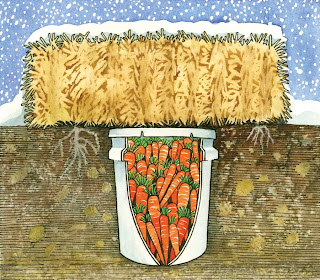
    You can also use Garbage cans that are sealed or galvanized for smaller storage areas or land allotments, you simply need a can (cut the bottom out or poke holes for drainage), straw and a bit of dirt for the inside in order to place your winter squash and root veggies in, the straw will be used to cover the top of the lid of the trash can in order to insulate it- of course you will need to dig a hole big enough to stick your can into.

To access your veggies, simply remove the tarp (opt), straw bale, and lift off the lid (if you want an additional security from rodents and moisture, put black tarp down over the straw bale on top of the lid and make sure there are drainage ditches on either side of the can and secure the tarp with cement blocks or heavy rocks) and then snatch however many veggies you need for supper and replace your insulation!

Remember to layer leaves or straw between the veggies!


Figure 4. A well box that supports an access hatch above ground level
Here is a good article from Back Woods Home Magazine that shows you how to build a small cold storage bin.

 Bury a Freezer or Refrigerator:
 

Stuff You’ll Need:
Straw Bales
Clear Plastic Sheeting
Plastic Sheeting
Shovel and Pick
Old Deep-freeze Or Refrigerator

Step 1:
Remove motor, shelves and lock from door (so no child can get locked inside).
Step 2:
Dig a hole large enough to hold the deep freeze where the top of the freezer is ground level or slightly below ground level.
Step 3:
Place some rocks in bottom of the hole for drainage.
Step 4:
Place the freezer into hole on its back. The door will open like a lid.
Step 5:
Fill around freezer with soil.
Step 6:
Place vegetables in freezer. Follow storage guidelines for vegetables just as if you were using a cellar.
Step 7:
Cover freezer with a sheet of plastic to keep water from freezing the lid shut.
Step 8:
Place bags of leaves or bales of hay or straw on top of the freezer to help with cold weather.

 Notes: Dig the hole one foot larger than the refrigerator on all sides to create drainage.  The refrigerator should sit just below ground level.  Line the hole with gravel or rocks.   Pour gravel in the space around the sides of the refrigerator.  Run a small vent pipe into the refrigerator for ventilation. Protect from water by covering the top with a large mat, board or other water resistant material.  Cover with bales of hay or straw to insulate. 

The amount of insulation will depend on your cold weather climate, so insulate accordingly, some will need more some less.

Looking for land in Missouri, Arkansas, Texas, or Minnesota in which to start your own homestead or garden in order to try out these new ideas?


Friday, September 28, 2012

Upcoming Local Events!

Here is a list of the upcoming local events in the Missouri Ozarks that you might want to mark on your calender to take the whole family to and enjoy!


Pioneer Days, September 29th all day. Held in Mountain View, Missouri downtown area near the Football Field and the "What" Park, there are vendors with hand made items, Food, Car Show, Cake Walk & Prizes, Music/Entertainment, Parade & Pioneer Days Trade vendors (IE: Blacksmiths/Old Crafts). Make it a family event, dress up as 1800's Pioneers and get pictures taken, so if you've ever wanted to dress up like the Beverly Hillbillies or Huckleberry Finn then here's your chance to some make memories this Saturday!

Here is the schedule of events:

6:30 am-11am Flapjack Breakfast at the Community Center
8:00 am: brad Jester will sing the National Anthem, following J.B Cantrell will ask a blessing for the day.
--Antique Car Show, sponsored by Landmark Bank, will be held on Oak Street again this year. It will be all day long, so drop by to see the old antique cars, trucks and tractors on display.
9:00 am: Lil' Darlin; & Lil' Dumplin Contest, sponsored by West Plains Bank/Liberty Branch
9:45 am: Billy Randolph will take the stage to perform. Billy is always a big favorite with the crowd.
10:00 am: The Bow Shoot, sponsored by the MO Dept of Conservation and Gary Lee Taylor, will be at the airport.
--The Conservation will once again be here to teach children how to fish.
10:00am: Wood competition will take place, sponsored by Roberts Wood Products.
10:15am: Red Hatters will line dance.
10:30am: On the stage is the big "Hillbilly Idol Contest". This event is being sponsored by Smith Flooring.
--Once again the Red Hatters will take the street to dance.
11:15am: Oren Granier and Roy Lee bond will be singing on the main stage.
--A new event this year is the Watermelon Eating Contest, sponsored by Mountain View Fabrication. Five contestants will site and eat watermelon to see who is the fastest.

Following this, the rest of the day as follows:
--Keith Bradshaw and Country Connection
--Women's Chamber Harvest Queen Contest
--Concert featuring country music singer Candy Coburn brought to you by Romines Ford of Houston. Following Candy's hour long concert, the Country Fire Cloggers will take the stage. They clog so hard and fast they shake the stage!
--Oren and Roy Lee will perform again.
3:00pm: Keith Bradshaw and the Country Connection
3:00pm: Parade lineup at Wayside Park
3:30pm: Country Fire Cloggers
4:00pm: Parade will roll down toward town.
--While waiting for the parade, Country Connection will keep the crowd entertained and you are encouraged to dance in the streets.


National Federation Bull Blast, Rock'n V Arena, September 29th at 7pm., Hwy 60 just out of Mountain View come and enjoy a great rodeo, mingle with Cowboys & Cowgirls and have a great time!


Farm Fest-Rootin' Tootin' Alpaca's held in Houston, Missouri located at the Rootin-Tootin Alpaca's Farm 16967 HWY B in Houston, 9am-4pm come see the animals on show, vendors, Alpaca wool home made scarfs, clothing and other accessories, food and more!


Summersville Pumpkin Fest, 10am - 4pm, October 6th, 2012 on the Square, Summersville, MO
Come and enjoy the day with games for the kids, contests, a tractor parade, a golf cart race, craft booths,  a Pumpkin cook off and much more!


Oz-Fall Fest, October 6th, 2012, 9am- 3:30pm, Willow Springs, MO on down town Main Street,  come follow the Yellow Brick road for Fun & Entertainment, Vendors, Games, Crafts, Contests, Booths and other Activities!


Dutch Oven Cook-off, Raymondville, MO located at the Raymondville Fairground on Saturday, October 13th, 2012 the cook-off will include a three pot dutch oven cook off with a Bread, Dessert and a Main Dish. Food turn will be at 12 noon, 12:30pm and 1 pm, there is a $20 entry fee per team. Awards will be presented to the first three places for each division.  Come out and watch or compete and enjoy some wonderful food! There are also other activities scheduled as part of the Raymondville Fall Fest. For an entry packet, contact Bob Roach at 417-457-6248 or email at roachw@wildblue.net


Monday, September 24, 2012

Tips on How to Buy Farmland, Even if you think you can't!

Here's some tips that we've found from an article out of Mother Earth News magazine that we hope will help you in your search for farmland, and you can also apply these tips and suggestions to looking for that perfect homesteading plot as well.


(Cite: "How to Buy Farmland, Even if you think you can't" By Ann Larkin Hansen, Mother Earth News Magazine.)

Tips:
  1. Be clear and realistic about the budget you'll need to support yourself and your farm, and about how you'll get the income you need.
  2.  Do your homework on the neighborhood and the land you're looking at to make sure it suits you and the type of farming (or homesteading) you want to do.
  3.  Think outside the box: Be open to different options and timetables for buying land.
  4. If you apply for a loan (or go through Owner Financing through our website), find out what mortgage lenders require from borrowers and get those requirements in order. (Homestead Crossing makes it easy to get the land you want with low monthly payments and down payments with Owner Financing with no interest for the first three years!)
Create a Farm Marketing Plan:

Good resources on this topic are "Growing for Market"  and the book "Market Farming Success" by Lynn Byczynski and the NSAIS is a great resource to figure out what you want to grow or raise and how to sell it. Also, consider veterinary costs into what your plan will be.

In the event of homesteading you will want to factor this in with your everyday expenses as well, and if you don't plan to sell the food you grow then allot for home canning costs, storage projects, etc.

Consider farm internships if you have no experience, you can find helpful resources on obtaining a local internship from the NSAIS website. Also, consider thinking outside the box, invent new ways of doing old things in a better, more efficient manner!

"Moooove over city living, hellooooo farm life!"


Monday, September 17, 2012

How to keep your Chickens laying Eggs through Winter without the use of Laying Pellets!

It can be frustrating and disappointing come winter time when you go out into the coop to get a nice dozen or so home grown farm fresh eggs for breakfast omelets and find that your hens are sitting together in a huddle with no eggs beneath them. Here are some tips to help your girls keep on laying through Winter and giving your family those delicious deep yolked eggs you love so much- without the need for laying pellets!


Light. A hen’s laying is influenced by her pineal gland, which in turn is controlled by daylight. Sixteen hours of light each day, supplemented by a 60-watt incandescent light bulb or two on a timer, is ideal for keeping birds active – and laying eggs. Also, this can shorten their egg laying lifespan.

Roosts. By nature, chickens like to roost at night. This is also their way to stay warm: with feathers fluffed, they share body heat by roosting close to each other. Make sure your chickens have comfortable roosts with 6-8 inches of roost space per bird. 

Heated water. Depending on how cold it gets where you live, you might need to keep the hens’ water supply from freezing. Feed stores sell heater bases that fit underneath the typical galvanized metal chicken waterers.

Deep litter. The deep litter method is low-maintenance, and it keeps hens warm through winter as the litter and manure slowly compost and release heat into the coop. Just start with a clean coop and about 4 inches of litter (hay, straw, wood shavings, or a mix) in the summer or early fall. Simply add more litter throughout the season as needed to keep the bedding fairly dry and clean. By winter, the litter should be about 8 to 10 inches deep. It will be composting nicely and giving off heat. The chickens’ scratching will keep it aerated and turned, especially if you throw scratch grains in the coop for them, but you can give it a hand with a pitchfork every once in a while.


Additional Notes:
You can also make a "sun room" for your gals in winter, like a green  house addition to the coop where they can get out and stretch their legs and not be smushed together over the cold months and spred a bit of straw or hay on the snow or icy ground, chickens don't like getting their feet cold below the 30 degree mark.

   Also, you can add a cabbage "ball" to the pen for them to play with and keep from getting bored, just tie the cabbage from the rafters and hang it low enough that your chickens can peck away at the ball and have a little fun too. Will keep the girls from going stir crazy- happy chickens = laying eggs!